Skin Longevity: A Dermatologist's Guide to Aging Gracefully at Every Decade
The Costly Mistake I See Every Week
Last month, a 34-year-old patient sat in my consultation room with a massive, overflowing bag of high-end skincare products. She'd followed every Instagram trend and bought every single "must-have" serum, yet her skin still looked tired, dull, and prematurely aged.
I asked her one question: "What order do you apply these in?"
She didn't know.
This is the paradox of modern skincare. More products than ever. More information than ever. And yet, most people are getting the fundamentals wrong — the very basics a dermatologist would check first.
That's what this guide is about. Not the latest trend. Not the most expensive cream. Just the evidence-based practices that actually move the needle for skin longevity — the science of keeping your skin healthy, resilient, and naturally youthful for as long as possible.
Let's start with what your skin actually needs at every stage of life.
What "Skin Longevity" Actually Means
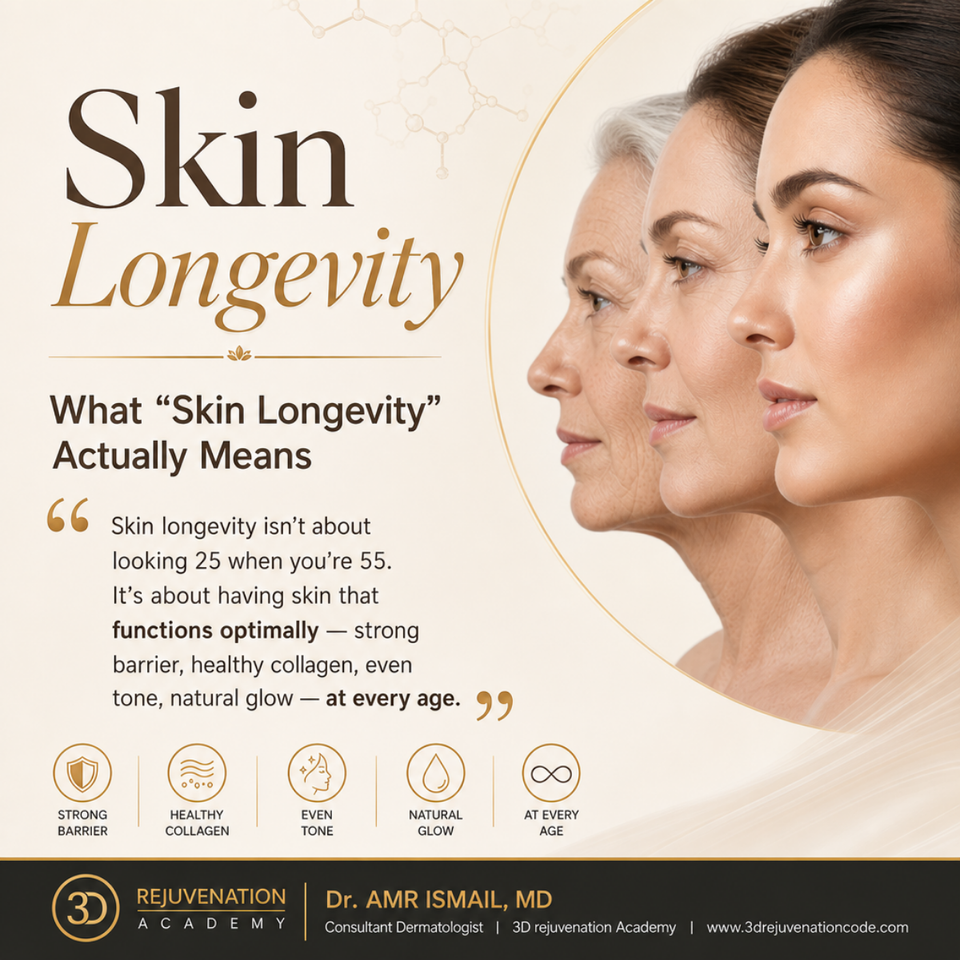
Skin longevity isn't about looking 25 when you're 55. It's about having skin that functions optimally — strong barrier, healthy collagen, even tone, natural glow — at every age.
Think of it like dental health. You don't brush your teeth to look 20 forever. You brush to keep them functional and healthy for a lifetime. The same principle applies to your skin.
The good news? Unlike your teeth, your skin has remarkable regenerative capacity. The right habits — started at any age — can measurably improve how your skin looks and performs.
The bad news? Most people waste years (and thousands of dollars) on products that address symptoms while ignoring the root causes.
Here's how to prevent aging skin at every decade — based on 30+ years of clinical dermatology practice.
Your 20s: Build the Foundation
What's happening: Your collagen production is at its peak. Your skin heals fast. This is your window to establish habits that pay dividends for decades.
The mistakes I see:
- Skipping SPF because "I don't burn"
- Using harsh products that damage the barrier
- Ignoring neck and chest in your routine
What to do instead:
1. SPF 30+ every single day. Not negotiable. Not just at the beach. Every. Single. Day. UV exposure is responsible for up to 80% of visible skin aging. The damage you accumulate in your 20s shows up in your 30s and 40s. Prevention now is infinitely easier than correction later.
2. Establish a simple, consistent routine. Cleanse, treat, moisturize, protect. Don't chase trends. Your skin doesn't need 12 products — it needs 4 good ones, used consistently.
3. Don't smoke. Limit alcohol. Sleep 7-8 hours. These aren't wellness clichés — they're collagen killers. I've seen 28-year-old smokers with the skin texture of 40-year-olds.
Your 30s: Introduce the Powerhouses
What's happening: Collagen production drops about 1% per year starting now. You may notice fine lines, subtle texture changes, and slower healing. This is when patients start panicking — and overspending.
The mistakes I see:
- Buying retinoids but using them wrong (too much, too often, giving up too early)
- Adding new products every week (your skin needs 6-8 weeks to show results)
- Neglecting the eye area
What to do instead:
1. Start retinoids — correctly. Begin with 0.025% or a gentle retinol, 2x per week. Apply a pea-sized amount to dry skin. Increase slowly over 8 weeks. The "purge" is real but temporary — most people quit at week 3, right before results appear.
2. Add Vitamin C in the morning. An antioxidant serum protects against environmental damage and brightens over time. Look for L-Ascorbic Acid at 10-20% concentration.
3. The Holy Trinity is now your foundation: Retinoids (night) + Vitamin C (morning) + SPF 30+ (morning). These three ingredients together address 90% of preventable aging. Everything else is optional.
4. Consider professional treatments strategically. A light chemical peel or microneedling session 2-3x per year can accelerate results dramatically. But only from a board-certified provider — not a medspa with a weekend certificate.
Your 40s: Repair and Support
What's happening: Collagen loss accelerates. Hormonal changes (perimenopause) can cause dryness, sensitivity, and uneven tone. This is when many patients say their skin "suddenly" changed.
The mistake I see: Waiting too long to adjust your routine. What worked at 32 won't work at 42. Your skin has different needs now.
What to do instead:
1. Upgrade your retinoid strength. If you've tolerated retinol well, consider stepping up to prescription tretinoin — it's the most studied anti-aging ingredient in dermatology.
2. Add peptides and growth factors. These support collagen synthesis and barrier repair. They won't replace retinoids, but they complement them beautifully.
3. Prioritize hydration. Your skin produces less natural moisture now. A good hyaluronic acid serum and a richer moisturizer aren't luxuries — they're necessities.
4. Address pigmentation early. Dark spots become harder to treat with time. A combination of Vitamin C, niacinamide, and professional treatments works best.
5. Consider in-office treatments. Radiofrequency, laser resurfacing, or strategic injectables — done conservatively by a qualified dermatologist — can restore what skincare alone cannot. But choose your provider carefully. Here's my 12-point checklist for evaluating any aesthetic provider.
Your 50s and Beyond: Restore and Maintain
What's happening: Post-menopausal skin loses collagen rapidly — up to 30% in the first 5 years after menopause. Dryness, thinning, and loss of elasticity are common concerns.
The mistake I see: Accepting decline as inevitable. Yes, your skin changes. But dramatic improvement is still absolutely possible with the right approach.
What to do instead:
1. Continue the fundamentals. The Holy Trinity (retinoids, Vitamin C, SPF) still works — never stop. You may need gentler formulations or less frequent application, but these ingredients remain essential.
2. Focus on barrier repair. A compromised barrier makes everything worse. Use ceramide-rich moisturizers and avoid over-exfoliation.
3. Consider biostimulatory treatments. Procedures like Sculptra or PRF (Platelet-Rich Fibrin) stimulate your body's own collagen production. Results develop gradually and look natural — because they are natural.
4. Don't forget your neck, chest, and hands. These areas have fewer oil glands and show age faster than your face. Extend your skincare routine beyond your jawline.
5. Work with a dermatologist, not against trends. At this stage, professional guidance becomes more valuable than ever. A personalized protocol will always outperform a one-size-fits-all routine.
The Inside-Out Factor: What Most People Ignore
Your skin is an organ. It reflects what's happening inside your body. No topical product can fully compensate for:
- Chronic inflammation (from poor diet, stress, or lack of sleep)
- Dehydration (most people are mildly dehydrated daily)
- Nutrient deficiencies (especially Omega-3s, zinc, and antioxidants)
The patients with the best skin in their 50s and 60s aren't necessarily the ones with the most expensive routines. They're the ones who sleep well, manage stress, eat whole foods, and stay hydrated.
I included a complete collagen nutrition strategy in my free Skin Longevity Starter Kit — the same dietary recommendations I give patients who want to support their skin from the inside out.
What to Skip (Save Your Money)
Before you add anything new, know what you don't need:
- Expensive cleansers: They wash down the drain. A gentle, pH-balanced formula is sufficient.
- Multiple serums layering: Overloading causes irritation. Pick 2-3 proven actives and stick with them.
- Trendy ingredients without evidence: If it doesn't have peer-reviewed studies behind it, be skeptical.
- At-home devices that promise too much: Most deliver marginal results compared to professional treatments.
Your Next Step
I've distilled everything in this guide — plus the specific morning and evening routines, the Holy Trinity ingredient breakdown, the weekly boost protocol, and the collagen nutrition strategy — into a free 5-page Skin Longevity Starter Kit.
It's the same framework I share with every new patient in my practice. No product brands, no affiliate links, just evidence-based guidance from 30+ years of clinical dermatology.
Get the free Skin Longevity Starter Kit here →
If you're considering any aesthetic treatments beyond skincare, I also created a 14-page Decision Checklist with 12 red flags to watch for, 15 questions to ask your dermatologist, and a 3-pillar scorecard to assess your readiness. You can learn more about it here.
About the Author: Dr. Amr Ismail, MD is a board-certified dermatologist with 30+ years of clinical experience. He is the founder of 3D Rejuvenation Academy, dedicated to helping patients make safe, informed decisions about their skin health.