Skincare Routine Steps: The Exact Order a Dermatologist Applies Products
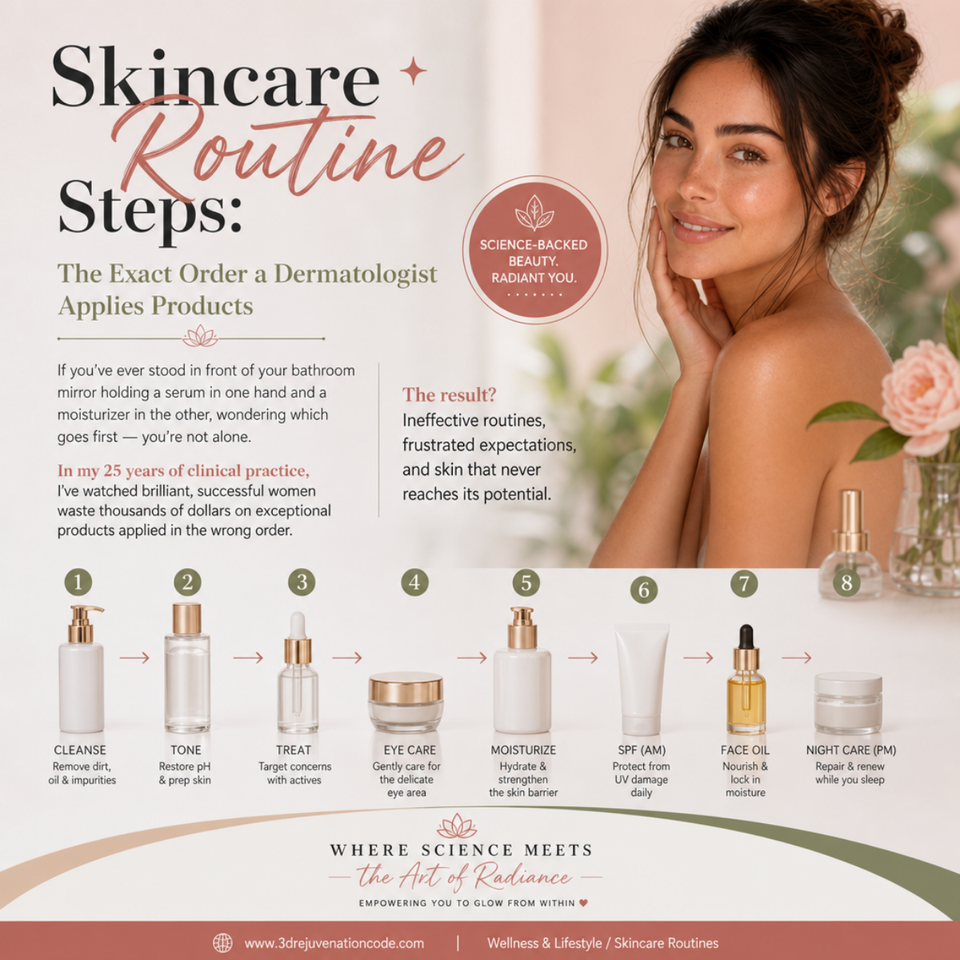
If you've ever stood in front of your bathroom mirror holding a serum in one hand and a moisturizer in the other, wondering which goes first — you're not alone. In my 25 years of clinical practice, I've watched brilliant, successful women waste thousands of dollars on exceptional products applied in the wrong order. The result? Ineffective routines, frustrated expectations, and skin that never reaches its potential.
Here's the truth that skincare marketing doesn't want you to know: the order in which you apply your products matters more than the price tag on the bottle. A $15 serum applied to clean, bare skin will outperform a $200 serum layered over a thick cream that blocks its penetration.
This guide will teach you the exact protocol I teach my patients — the same order I follow in my own routine every morning and night. No fluff, no sponsored product placements, just the evidence-based system that has worked for thousands of women across every skin type and life stage.
Why Skincare Routine Order Actually Matters
Your skin is a biological barrier, not a blank canvas. It has a specific structure — the stratum corneum, the outermost layer — that determines how and whether products penetrate. Think of it like a sieve: small, water-based molecules pass through easily. Large, oil-based molecules sit on top.
The fundamental rule: Apply products from thinnest (most watery) to thickest (most oily/occlusive). Light serums must touch skin directly to penetrate. Heavy creams and balms go last to seal everything in and prevent water loss.
When you reverse this order — say, applying a vitamin C serum over your moisturizer — you create an occlusive barrier that blocks penetration. The active ingredient never reaches the living cells where it can actually work. You're essentially flushing money down the drain.
The second critical principle: Active ingredients need direct contact with skin to be effective. Retinoids, acids, and antioxidants all require penetration into the epidermis (and sometimes the dermis) to trigger biological changes. Anything that blocks this pathway — whether it's the wrong product order or a barrier of dead skin cells — reduces efficacy.
The Dermatologist's Morning Routine: Protect
Morning skincare has one primary objective: protection. Your skin faces a daily assault from UV radiation, pollution, blue light, and environmental stressors. A well-structured morning routine creates a defensive shield while delivering protective antioxidants.
Step 1: Cleanse
Every morning, without exception. While you sleep, your skin produces sebum, sheds dead cells, and deposits metabolic byproducts on the surface. Morning cleansing removes this overnight buildup and creates a clean canvas for everything that follows.
•Dry or sensitive skin: A cream or oil-based cleanser that cleans without stripping
•Normal or combination skin: A gentle gel cleanser that balances cleaning with barrier respect
•Oily or acne-prone skin: A foaming or salicylic acid cleanser to regulate morning oil production
Pro tip: Use lukewarm water, never hot. Hot water strips lipids from your barrier and triggers compensatory oil production — making oily skin oilier and dry skin drier.
Step 2: Treat — Antioxidant Serum
Every morning, immediately after cleansing. This is where your most important daytime active lives: vitamin C. As a dermatologist, I consider morning vitamin C as essential as sunscreen — and the two actually work synergistically.
•It neutralizes free radicals from UV and pollution throughout the day
•It inhibits melanin production, preventing dark spots before they form
•It supports collagen synthesis, maintaining skin firmness over time
Look for L-Ascorbic Acid at 10-20% concentration. Apply 3-4 drops on slightly damp skin. Press and pat — don't rub aggressively. Allow 60-90 seconds of absorption time before your next step.
Step 3: Hydrate (Optional)
As needed based on your skin's hydration status. Not every skin type needs a separate hydrating step. Oily skin often produces enough natural moisture. Dry and dehydrated skin benefits enormously from added humectants.
Use a hyaluronic acid serum (1-2% concentration) applied to damp skin. Hyaluronic acid is a humectant — it draws water into the skin from the environment and deeper layers. Applied to dry skin in a dry climate, it can actually pull water out of your skin. The damp-skin application is critical.
Step 4: Moisturize
Every morning, after your treatment serums. Moisturizer serves two purposes: it delivers beneficial lipids and occlusives to your skin, and it seals in the actives you've already applied. Think of it as a protective blanket over your treatment layers.
•Dry skin: A rich cream with ceramides, squalene, and fatty acids
•Normal skin: A balanced lotion with niacinamide and lightweight oils
•Oily skin: An oil-free, non-comedogenic gel moisturizer
•Combination skin: A lightweight lotion, possibly layering richer cream on dry areas only
•Sensitive skin: A barrier-repair formula with minimal ingredients, no fragrance
Step 5: Sunscreen — The Non-Negotiable Final Step
Every single morning. Rain or shine. Indoors or outdoors. If you do nothing else, cleanse and apply sunscreen. UV radiation is responsible for approximately 80% of visible skin aging — wrinkles, dark spots, loss of firmness, and texture changes.
Sunscreen needs to form an even, uninterrupted film on the surface of your skin to function. Applying moisturizer or makeup over sunscreen is fine — these sit on top of the protective layer. But applying sunscreen under moisturizer disrupts this film and creates gaps in protection.
Use SPF 30 minimum for daily incidental exposure. SPF 50 for extended outdoor time. Apply a quarter-teaspoon for face and neck combined. The best sunscreen is the one you'll actually wear every day.
The Dermatologist's Evening Routine: Repair
Nighttime is when your skin shifts from defense to repair. Blood flow increases, cell turnover accelerates, and collagen synthesis peaks. Your evening routine should support and enhance this natural regeneration process.
Step 1: Cleanse — The Double Cleanse
Every evening, thoroughly. Your evening cleanse must remove sunscreen (which is designed to adhere to skin), makeup, pollution particles, and excess sebum accumulated throughout the day.
First cleanse: An oil-based cleanser or cleansing balm. Oil dissolves oil — this step breaks down sunscreen, makeup, and sebum. Massage onto dry skin for 60 seconds, then emulsify with water and rinse.
Second cleanse: Your regular water-based cleanser. This step removes any residue from the first cleanse and actually cleans the skin surface.
Step 2: Treat — Your Active Ingredient
3-5 nights per week (not every night). This is the step that transforms skin — but it's also where most people cause damage. The golden rule: one active per night. Never stack multiple strong actives.
•Retinoids (vitamin A): The gold standard for anti-aging and acne. Increase cell turnover, stimulate collagen, unclog pores. Start with 0.25% retinol 2x per week.
•Exfoliating acids: AHAs (glycolic, lactic) for surface renewal. BHAs (salicylic acid) for pore penetration and acne. Use 1-2x per week maximum. Never on the same night as retinoids.
•Targeted treatments: Azelaic acid for rosacea and pigmentation. Niacinamide for barrier support. Peptides for firming.
Apply to completely dry skin. Wait 20 minutes after cleansing if using retinoids. Use a pea-sized amount for the entire face. Avoid the eye area unless using a specifically formulated eye retinoid.
Step 3: Hydrate
Every evening, especially on active-ingredient nights. Retinoids and acids can compromise your skin barrier temporarily. A hydrating serum replenishes water content and soothes any potential irritation.
Use hyaluronic acid, panthenol (vitamin B5), or centella asiatica-based hydrators. These are generally non-reactive and complement your active ingredients.
Step 4: Moisturize
Every evening, as your final substantial step. Night moisturizers can be richer than daytime versions. Your skin loses more water overnight (transepidermal water loss peaks while you sleep), and richer formulas support barrier repair during your body's regeneration window.
The sandwich method for retinoid users: If you experience irritation, apply a thin layer of moisturizer, then your retinoid, then another layer of moisturizer. This buffers the active ingredient while still allowing penetration.
Step 5: Eye Care (Optional)
If you use a separate eye product, apply it as your final step. The skin around your eyes is thinner and more delicate than the rest of your face. It benefits from targeted formulas that address specific concerns without the irritation potential of facial actives.
The Complete Routine at a Glance
|
Step |
Morning |
Evening |
|
1. Cleanse |
Gentle cleanser |
Double cleanse (oil + water-based) |
|
2. Treat |
Vitamin C serum |
ONE active: retinoid OR acid |
|
3. Hydrate |
HA serum (if needed) |
Hydrating serum |
|
4.
Moisturize |
Day cream |
Richer night cream |
|
5. Protect |
SPF 30+ (final step) |
— |
|
6. Eye
Care |
— |
Optional: eye cream (final step) |
Common Layering Mistakes That Waste Your Products
Mistake 1: Applying serum over moisturizer
This is the most common and costly error. Serums are formulated with small molecules to penetrate deeply. Moisturizers create an occlusive film. Layering serum over moisturizer traps the active ingredients on the surface where they cannot work.
Mistake 2: Using too many actives at once
The 'more is more' approach destroys skin barriers. I've treated countless women who damaged their skin by using retinoids, vitamin C, and exfoliating acids daily. The result: redness, sensitivity, breakouts, and sometimes post-inflammatory hyperpigmentation that takes months to resolve.
Mistake 3: Not waiting between layers
While you don't need to wait hours between steps, allowing 30-60 seconds of absorption time prevents products from mixing on the surface and potentially destabilizing each other.
Mistake 4: Applying sunscreen mid-routine
Sunscreen must be your final skincare step before makeup. Any product applied over it disrupts the protective film and creates gaps in coverage.
Mistake 5: Inconsistent routine switching
The most effective skincare routine is the one you'll actually follow consistently. Switching products every week prevents your skin from ever reaching the results phase of any single ingredient. Give each new addition 4-6 weeks before evaluating its impact.
Adapting This Routine to Your Skin Type
While the fundamental order stays the same, your product choices should align with your skin type. I've created a comprehensive guide to help you identify your true skin type and build a personalized routine around it.
Download The Skin Type Decoder — a free guide that walks you through a 5-question dermatologist-designed assessment and gives you the exact routine for your specific skin type.
Quick Skin Type Adjustments:
•Dry skin: Use cream or oil cleansers. Prioritize hyaluronic acid layering. Choose rich, ceramide-based moisturizers. Be cautious with retinoid frequency — start 1x per week.
•Oily skin: Use gel or foaming cleansers. You can often skip the separate hydrating step. Choose oil-free, non-comedogenic moisturizers. Retinoids regulate oil production over time.
•Combination skin: Use balancing gel cleansers. Consider zone-specific treatment — lighter products on the T-zone, richer products on cheeks. Niacinamide is your universal ingredient.
•Sensitive skin: Use ultra-gentle cleansers. Limit actives significantly. Prioritize barrier repair ingredients (ceramides, centella, allantoin). Always patch test new products.
•Normal skin: Maintain your balance with consistent, moderate routines. Focus on prevention with vitamin C, gentle retinoids, and adequate sun protection.
The Skin Cycling Method: An Alternative Approach
For those who want to use multiple actives without overloading their skin, skin cycling — popularized by dermatologist Dr. Whitney Bowe — offers an elegant solution.
|
Night |
Active |
Purpose |
|
Night 1 |
Exfoliation (AHA or BHA) |
Surface renewal |
|
Night 2 |
Retinoid |
Cell turnover + collagen |
|
Night 3 |
Recovery (no actives) |
Barrier repair |
|
Night 4 |
Recovery (no actives) |
Barrier repair |
This method spaces out powerful actives while dedicating specific nights to barrier recovery. It's particularly effective for sensitive skin types who struggle with daily active use, and for beginners introducing retinoids for the first time.
When to Expect Results
One of the most common sources of skincare frustration is unrealistic timing expectations. Your skin operates on a biological timeline that no product can accelerate beyond certain limits.
•Immediate (same day): Hydration from moisturizers and hyaluronic acid. Smoothness from silicones in some formulas.
•2-4 weeks: Reduced oiliness from niacinamide. Initial improvement in texture from consistent cleansing. Early brightening from vitamin C.
•6-12 weeks: Visible reduction in fine lines from retinoids. Fading of dark spots. Improvement in acne from salicylic acid or retinoids.
•3-6 months: Significant collagen stimulation from retinoids. Substantial improvement in skin firmness and elasticity. Major fading of established hyperpigmentation.
The bottom line: Skincare is a marathon, not a sprint. The women I see with the best skin in their 40s, 50s, and 60s started consistent routines in their 20s and 30s and maintained them. It's never too late to start — but consistency over decades is what creates truly exceptional skin.
Final Thoughts From the Clinic
The women who achieve the best results in my practice share three characteristics: they're consistent, they're patient, and they keep it simple. The most elaborate 12-step routine will never outperform a simple 4-step routine that's followed diligently for years.
Your skin is a living organ, not a project to be completed. It changes with seasons, hormones, stress, and age. The goal isn't perfection — it's building a responsive, adaptable routine that supports your skin through every phase of life.
Start with the order outlined in this guide. Identify your skin type honestly. Choose quality products within your budget. And then — this is the hard part — be consistent for long enough to let the science work.
Stop guessing. Start glowing.
Dr. Amr Ismail, MD is a Consultant dermatologist and creator of the C-ECM-AS Protocol with 25+ years of clinical experience in aesthetic medicine and skin health. He founded 3D Rejuvenation Code to bridge the gap between clinical dermatology and accessible, evidence-based skincare education.