Why the "Fill-and-Freeze" Era Is Ending — And What Replaces It
A Clinical Philosophy for the Next Generation of Aesthetic Medicine
For nearly two decades, aesthetic medicine has operated on a deceptively simple premise: see a wrinkle, fill it. See a hyperdynamic line, freeze it. See volume loss, replace it. This "fill-and-freeze" paradigm has built billion-dollar industries, trained tens of thousands of practitioners, and delivered visible, immediate results to millions of patients worldwide. On the surface, it has been an extraordinary success.
But beneath that surface, a quiet crisis has been building.
The patients who return every six months — not because they want to, but because they must — are telling us something. The practitioners who watch results diminish with each successive treatment are seeing something. The tissue itself, progressively altered, thinned, and dependent, is revealing something that the fill-and-freeze model was never designed to address: aging is not a surface problem. It is a biological event.
This article is not a critique of injectables, lasers, or energy-based devices. These tools remain essential. Rather, it is a call to evolve how we think about them — to shift from a reactive, symptom-masking approach to a regenerative, biology-first framework. That framework is the 3D Rejuvenation Code, and it represents the most significant conceptual advance in aesthetic medicine since the introduction of botulinum toxin itself.
I. The Anatomy of a Paradigm: How Fill-and-Freeze Conquered — and Constrained — Aesthetic Medicine
To understand why the fill-and-freeze era must end, we must first understand why it began. The introduction of botulinum toxin for cosmetic use in the late 1980s and early 1990s, followed by the FDA approval of hyaluronic acid fillers in 2003, revolutionized aesthetic practice. For the first time, physicians could offer non-surgical interventions with predictable outcomes, minimal downtime, and immediate patient satisfaction. The business model was elegant: treat, observe improvement, retreat when the effect wore off. Repeat indefinitely.
This model aligned perfectly with the prevailing medical culture of the time — one that prioritized symptom management over root-cause resolution. In cardiology, we managed cholesterol. In endocrinology, we managed blood sugar. In aesthetics, we managed wrinkles and volume loss. The parallel seemed natural, even scientific.
But there was a fundamental difference. In metabolic medicine, symptom management is often necessary because the underlying disease process cannot be fully reversed. In aesthetic medicine, the underlying biology — the extracellular matrix, the fibroblast population, the collagen architecture, the cellular signaling environment — is not irreversibly damaged in most patients. It is dormant. Neglected. Starved of the mechanical and biochemical stimuli that maintain its vitality.
The fill-and-freeze approach, by treating appearance as an isolated surface phenomenon, inadvertently accelerated the very process it sought to camouflage. Repeated volumization without structural support stretched compromised matrices. Repeated neurotoxin injection without tissue conditioning atrophied the muscular and dermal interface. Patients looked better temporarily, but their tissue functioned worse progressively. The gap between appearance and biology widened with each treatment cycle.
By 2020, the data was becoming undeniable. Studies began documenting filler-induced tissue expansion, chronic inflammatory responses, and the phenomenon of "filler fatigue" — where patients required increasingly larger volumes to achieve diminishing returns. The industry responded not by questioning the paradigm, but by developing longer-lasting products, higher cross-linking densities, and more potent neurotoxin formulations. We were treating the symptoms of a failing model with more aggressive versions of the same model.
II. The Biological Reality: Aging as Systematic Failure of Tissue Homeostasis
The 3D Rejuvenation Code begins with a radical redefinition: aging is not the accumulation of wrinkles, lines, or volume loss. Aging is the systematic failure of tissue homeostasis — the gradual collapse of the biological systems that maintain, repair, and regenerate the extracellular matrix (ECM).
To appreciate this, we must understand what the ECM truly is. It is not, as commonly misconceived, a passive filler or inert scaffolding between cells. The ECM is a dynamic, signaling-rich environment that actively instructs cellular behavior. It contains not only collagen fibers and elastin networks, but also ground substance (hyaluronic acid, proteoglycans), growth factors, cytokines, matrix metalloproteinases, and their inhibitors. It houses fibroblasts, immune cells, stem cell niches, and the vascular networks that feed them all.
In the healthy state, this ecosystem operates as a self-regulating unit. Mechanical forces from facial expression, mastication, and even gravity stimulate fibroblasts to produce collagen and elastin. Growth factors maintain cellular turnover. The ground substance retains hydration and facilitates nutrient exchange. The matrix is alive, responsive, and resilient.
With chronological aging, and accelerated by hormonal decline, ultraviolet exposure, and lifestyle factors, this homeostasis begins to fail. Fibroblasts enter a state of cellular senescence — not dead, but dormant. They downregulate collagen synthesis, upregulate matrix-degrading enzymes, and lose their mechanosensory responsiveness. The collagen framework becomes disorganized and fragmented. Elastin loses its elastic recoil. Ground substance dehydrates. The signaling environment shifts from regenerative to inflammatory.
The visible signs — wrinkles, laxity, flattening, dryness — are not the disease. They are the symptoms. The disease is the loss of cellular activation and matrix integrity. Treating the symptoms without addressing the disease is the clinical equivalent of painting over mold. It looks better temporarily, but the structure continues to decay beneath the surface.
This biological reality has profound implications for how we design treatments. A patient with recurrent laxity after repeated volumization is not presenting a product deficit. They are presenting a structural and cellular problem. Injecting more filler into a degraded matrix is like pouring concrete onto crumbling rebar. It adds mass without restoring architecture. It creates the illusion of support while the foundation continues to erode.
III. The 3D Rejuvenation Code: From Symptom Management to Biocellular Architecture
The 3D Rejuvenation Code is not a product. It is not a device. It is a clinical philosophy that restructures how we think about, diagnose, and treat aesthetic concerns across the entire body — from the face to the intimate anatomy. It is built on three pillars, each addressing a distinct but interconnected dimension of tissue regeneration.
PILLAR ONE: THE SPARK — Mechanical Energy-Based Activation
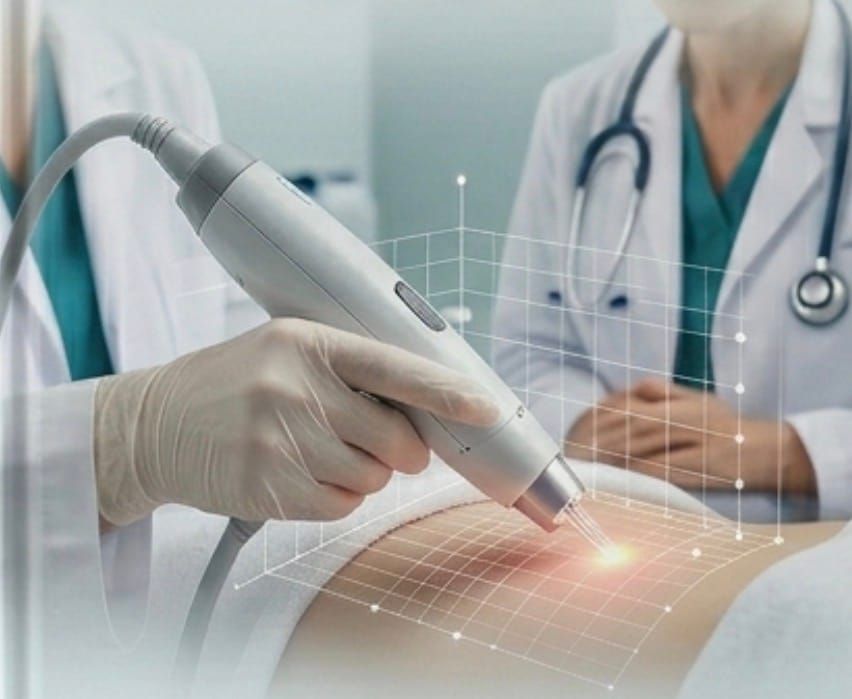
The Spark is the catalyst. It is the definitive mechanical trigger that reawakens what has gone dormant. In the aging dermis, fibroblasts have lost their mechanosensory responsiveness. They no longer "hear" the mechanical forces that once stimulated collagen production. The Spark — delivered through precisely controlled energy-based modalities such as fractional radiofrequency, microfocused ultrasound, or calibrated laser systems — restores this mechanical dialogue.
The mechanism is elegant. Mechanical energy creates controlled micro-injuries that activate the body's wound-healing cascade. Heat shock proteins are upregulated. TGF-β signaling is initiated. Fibroblasts transition from their dormant, senescent state to an activated, biosynthetic phenotype. Neo-collagenesis begins. The tissue is not filled from the outside; it is instructed to rebuild from the inside.
Critically, The Spark is not about destruction. It is about activation at the threshold of biological response. The practitioner must understand tissue tolerance, energy density, and the specific mechanobiology of the treatment area. In the vulvovaginal complex, for example, the epithelial and stromal layers require different energy parameters than facial dermis. The Spark must be calibrated, not standardized.
PILLAR TWO: THE BRAIN — Cellular Intelligence and ECM Reprogramming
If The Spark is the ignition, The Brain is the intelligence that directs what happens next. The Brain represents the cellular and molecular reprogramming that transforms a transient wound response into sustained tissue improvement.
This pillar addresses the signaling environment of the ECM. In the aging matrix, the balance between matrix synthesis and degradation has shifted toward destruction. MMPs (matrix metalloproteinases) dominate over their inhibitors. Inflammatory cytokines suppress regenerative growth factors. The cellular script has been rewritten toward senescence.
The Brain pillar intervenes at this level. Biostimulatory agents — whether poly-L-lactic acid, calcium hydroxylapatite, or advanced growth factor formulations — provide the signaling molecules that an activated matrix can now utilize. But timing is everything. Administering these agents to dormant tissue is wasteful; the cells cannot respond. Administering them after The Spark, when fibroblasts are in their activated window, is transformative.
The Brain also encompasses the emerging field of exosomal therapy and cellular secretome applications. These modalities do not merely add volume or structure; they deliver the molecular instructions — microRNAs, proteins, lipids — that reprogram cellular behavior toward a younger phenotypic state. This is not science fiction. It is the current frontier of regenerative aesthetics, and it sits squarely within the Brain pillar of the 3D Rejuvenation Code.
PILLAR THREE: THE BONE — Structural Restoration and Architectural Support
The Bone is the foundation. It is the structural pillar that ensures the transformation initiated by The Spark and directed by The Brain can be sustained over time.
In aesthetic medicine, we have long conflated volume with structure. They are not the same. Volume is the space occupied by tissue. Structure is the architectural framework that maintains that space against gravity, movement, and time. A patient with facial flattening may have adequate volume but compromised structure — fragmented collagen, degraded elastin, loss of the deep fascial support system.
Structural restoration requires a different approach than volumization. It requires agents and techniques that integrate with the existing matrix to rebuild architectural integrity. In the face, this may involve deep plane support with collagen-stimulating products placed at the level of the retaining ligaments. In the intimate anatomy, it may involve restoration of the structural support system of the vulvovaginal complex — the collagen framework of the labia majora, the elastin networks of the vestibule, the ground substance hydration of the mucosal surfaces.
The Bone pillar also encompasses the concept of "structural maintenance" — protocols that protect the restored architecture from the environmental and mechanical forces that would degrade it anew. This includes evidence-based skincare, hormonal optimization where indicated, lifestyle modification, and periodic maintenance activation sessions. Without maintenance, even the most elegant restoration will eventually succumb to the same biological forces that caused the initial decline.
IV. The Clinical Shift: What This Means for Practitioners
Adopting the 3D Rejuvenation Code requires more than learning new techniques. It requires a fundamental shift in clinical thinking — from product-centric to diagnosis-driven, from appearance-focused to biology-focused, from reactive to regenerative.
The Diagnostic Revolution
The first change is in how we assess patients. The traditional aesthetic consultation focuses on visible deficits: "Where are the wrinkles? Where is the volume loss? Where are the asymmetries?" The 3D Rejuvenation consultation asks different questions: "What is the state of the ECM? Are the fibroblasts dormant or active? Is the structural framework intact or compromised? What does this tissue need to heal itself?"
This requires new assessment tools. Clinical palpation to evaluate tissue turgor and recoil. Imaging modalities to assess collagen density and elastin integrity. Biochemical markers where available. And above all, a trained clinical eye that reads tissue quality, not just tissue quantity.
The Sequencing Imperative
The second change is in how we sequence treatments. In the fill-and-freeze model, the sequence was often arbitrary — whatever the patient requested, or whatever the practitioner preferred. In the 3D Rejuvenation Code, sequence is biological. You cannot reprogram a dormant matrix. You cannot structurally support tissue that has not been activated. You cannot maintain what has not been built.
The correct sequence is non-negotiable: Spark first, Brain second, Bone third, Maintenance ongoing. Violating this sequence is not merely suboptimal; it is clinically counterproductive. Attempting to volumize before activation stretches a compromised matrix. Attempting to biostimulate before activation wastes product on unresponsive cells. The biology dictates the protocol, not the practitioner's schedule or the patient's impatience.
The Outcome Revolution
The third change is in how we measure success. The fill-and-freeze model measures appearance: "Do the wrinkles look softer? Does the face look fuller?" The 3D Rejuvenation Code measures biology: "Is the tissue functioning better? Is the matrix producing collagen? Is the structural support self-sustaining?"
This shift has profound implications for patient communication and expectation management. Patients must understand that regeneration takes time — collagen synthesis does not peak until 3–6 months post-activation. They must understand that the goal is not instant gratification but lasting transformation. And they must understand that maintenance is not failure; it is the protection of investment.
For the practitioner, this outcome framework is liberating. Instead of chasing ever-diminishing returns with ever-larger volumes, the practitioner builds tissue that increasingly sustains itself. Patient satisfaction deepens rather than plateaus. The clinical relationship evolves from transactional ("I need more filler") to transformational ("My tissue is responding").
V. What This Means for Patients: Beyond the Mirror
For patients, the shift from fill-and-freeze to the 3D Rejuvenation Code represents something far more significant than a new treatment option. It represents a new relationship with their own biology — one based on restoration rather than replacement, on activation rather than camouflage, on partnership with their tissue rather than dependence on products.
The educated patient of 2026 is different from the patient of 2010. She has access to information. She reads studies. She asks about long-term outcomes, not just immediate results. She is increasingly skeptical of the "more is better" approach that has dominated aesthetic marketing. And she is often the one who initiates the conversation about "natural" or "regenerative" approaches.
What she is really asking for — even when she does not have the vocabulary — is the 3D Rejuvenation Code. She wants her tissue to work better, not just look better. She wants results that last because the underlying biology has improved, not because more product has been deposited. She wants to feel that her treatment is aligned with her body's own healing capacity, not fighting against it.
In aesthetic gynecology, this patient desire is even more acute. The woman who presents with intimate concerns — dryness, laxity, altered contour, reduced sexual confidence — is rarely experiencing a cosmetic problem. She is experiencing a functional and existential one. She does not want to "look younger" in a place no one sees. She wants to feel whole, responsive, and at home in her own body again.
The fill-and-freeze model has almost nothing to offer her. Volumization of intimate anatomy without structural and cellular restoration is not merely inadequate; it can be harmful, creating distortion without function, mass without meaning. The 3D Rejuvenation Code, by contrast, addresses the full dimensionality of her concern — the structural support that maintains contour, the cellular activation that restores hydration and elasticity, the biological reprogramming that returns tissue to a younger functional state.
When she says, "I want to feel like myself again," she is describing the outcome of the 3D Rejuvenation Code. Not because a product made her look different, but because her biology was restored to its own remembered capacity.
VI. The Future: From Aesthetic Medicine to Regenerative Aesthetics
The 3D Rejuvenation Code is not the endpoint of this evolution. It is the foundation. As our understanding of cellular senescence, mechanobiology, and matrix immunology deepens, the framework will expand. We will see more precise activation modalities, more sophisticated biostimulatory agents, and more personalized structural support systems.
The integration of artificial intelligence into tissue assessment will allow practitioners to predict ECM response before treatment, customizing Spark parameters to individual tissue phenotypes. The advancement of cellular secretome therapies will make The Brain pillar increasingly powerful, potentially reversing senescence at the molecular level. And the development of bioengineered structural matrices may one day allow us to rebuild architectural support with materials that are not merely tolerated by the body, but actively integrated into its regenerative processes.
But even as the tools evolve, the philosophy remains constant: treat the biology, not the symptom. Activate before you augment. Reprogram before you replace. Build structure that sustains. And never forget that the ultimate goal is not a younger appearance, but a healthier, more resilient, more functional tissue system.
The fill-and-freeze era gave aesthetic medicine its legitimacy and its commercial success. It brought these treatments out of the shadows and into mainstream medical practice. For that, it deserves recognition. But its time as the dominant paradigm is ending. The patients are ready for more. The science is ready for more. And the practitioners who lead the next decade will be those who are ready to offer it.
The future belongs to regenerative aesthetics. The future belongs to the 3D Rejuvenation Code.
Conclusion: The Choice Before Us
Every practitioner in aesthetic medicine today faces a choice. We can continue within the fill-and-freeze paradigm — treating symptoms, managing appearances, and accepting the progressive decline of tissue function as an unavoidable cost of cosmetic improvement. Or we can step into the regenerative paradigm — diagnosing biology, activating cellular machinery, reprogramming matrix signaling, and restoring structural integrity in ways that sustain themselves.
The first path is familiar, profitable in the short term, and increasingly unsatisfying for both patient and practitioner. The second path requires new knowledge, new skills, new patience, and new ways of measuring success. It is the harder path. It is also the only path that leads where aesthetic medicine must go.
The 3D Rejuvenation Code is not a rejection of what came before. It is the evolution of it. The injectables, the lasers, the energy devices — these are still our tools. But they are no longer our strategy. The strategy is regeneration. The strategy is biocellular architecture. The strategy is treating the patient as a living biological system, not a surface to be smoothed.
The fill-and-freeze era is ending. Not with a bang, but with a growing recognition that there is a better way. The practitioners who recognize this now will define the next generation of aesthetic medicine. The patients who demand it now will receive care that honors the full dimensionality of their biology.
The Spark is lit. The Brain is awakening. The Bone is being rebuilt.
Welcome to the era of biocellular restoration.
—
© 2026 Amr Ismail, MD | 3D Rejuvenation Code | 3drejuvenationcode.com