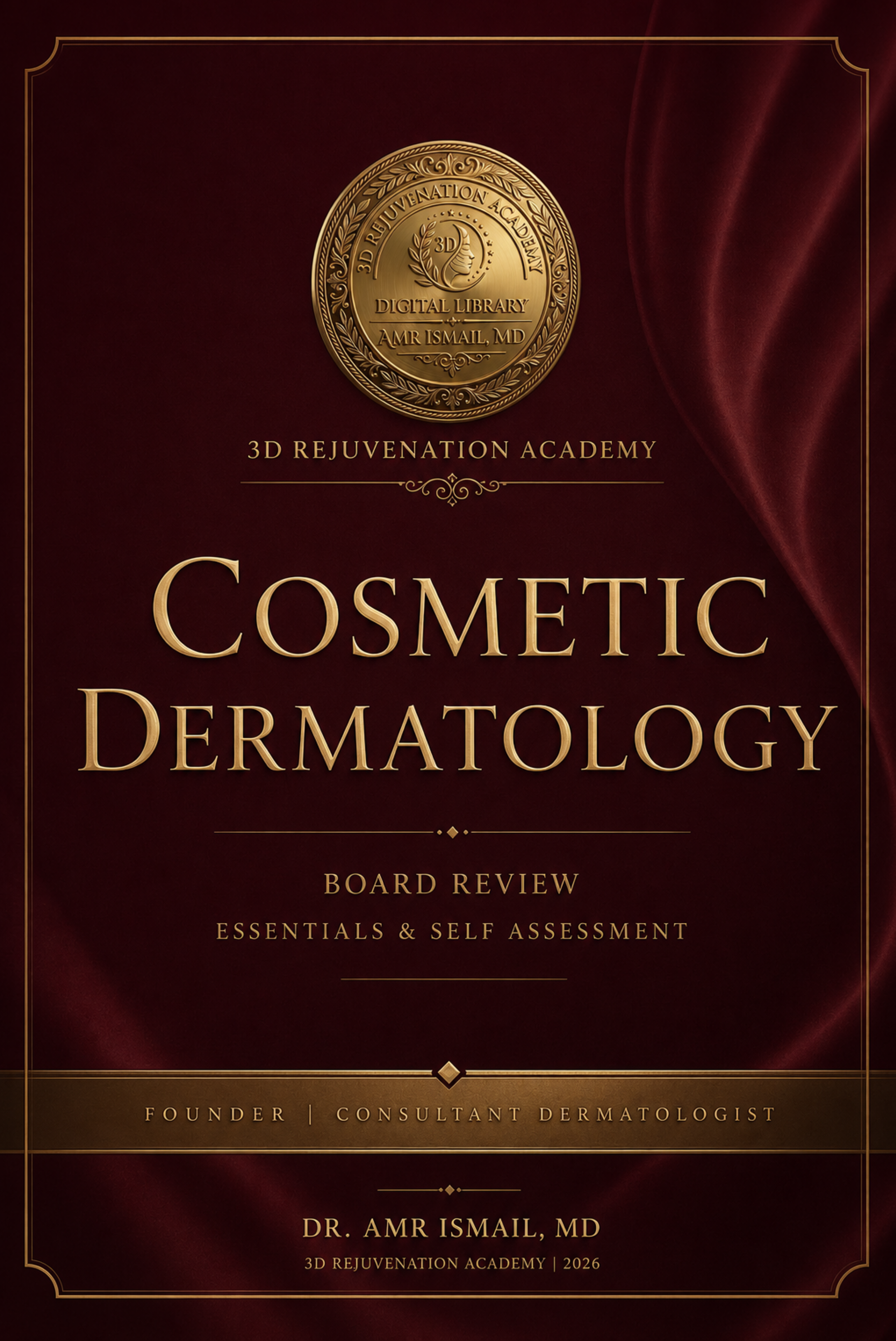
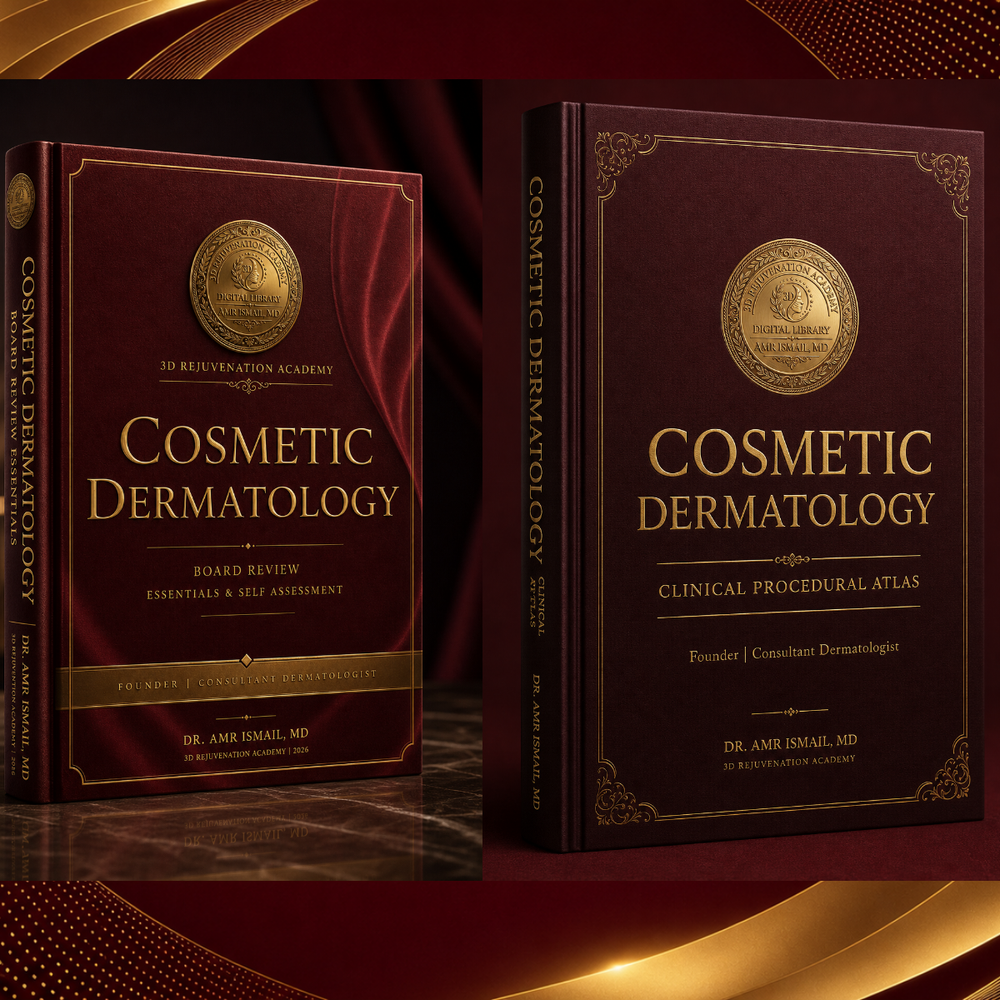
Cosmetic
Cosmetic
Dermatology
Board Review Essentials — Master Tables, Protocols, Complications & Exam Traps
A comprehensive 10-part self-study system integrating peer-reviewed research, clinical trial data, international consensus guidelines, and expert protocols. Covering injectables, energy devices, biostimulation, body contouring, intimate rejuvenation, and Board Review Essentials.
Parts
Based Words
Citations
Essentials
The Definitive Evidence-Based Reference for Cosmetic Dermatology
A comprehensive 10-part self-study system integrating peer-reviewed research, clinical trial data, international consensus guidelines, and expert protocols into a single authoritative digital resource.
Dermatology Residents
Building foundational knowledge in aesthetic procedures during training, preparing for board certification, and developing clinical confidence before independent practice.
Practicing Dermatologists
Staying current with rapidly evolving techniques, evidence-based protocols, product comparisons, and complication management strategies for safe, optimal patient outcomes.
Aesthetic Medicine Physicians
Expanding procedural repertoire from injectables to energy devices, body contouring, and regenerative therapies with research-backed treatment algorithms.
Licensed RNs & PAs
Working under physician supervision with detailed safety protocols, injection techniques, contraindication screening, and emergency management procedures.
Clinic Owners
Training clinical teams with standardized protocols, ensuring consistent quality of care, and maintaining practice-wide safety standards.
Evidence-Based Approach
Peer-Reviewed Sources
All clinical recommendations are supported by citations from PubMed-indexed journals, including randomized controlled trials, systematic reviews, meta-analyses, and international consensus guidelines from ASAPS, ASDS, ASLMS, and ESCAD.
Hierarchy of Evidence
Level I evidence (RCTs, systematic reviews) is prioritized. Where Level I evidence is unavailable, Level II-III evidence (cohort studies, expert consensus) is clearly labeled. Anecdotal claims are excluded.
Product-Neutral Position
This publication maintains independence from industry influence. Product comparisons are based on published data including G-prime measurements, clinical trial outcomes, and safety profiles — not manufacturer claims.
Safety-First Framework
Every section includes dedicated safety profiles, contraindication lists, complication rates from registry data, and evidence-based emergency management protocols. The TOPPASS safety framework is applied throughout.
Continuously Updated
The 2026 Edition reflects the latest available evidence. Subscribers receive priority access to content updates as new research, FDA approvals, and consensus guidelines are published.
Book Contents
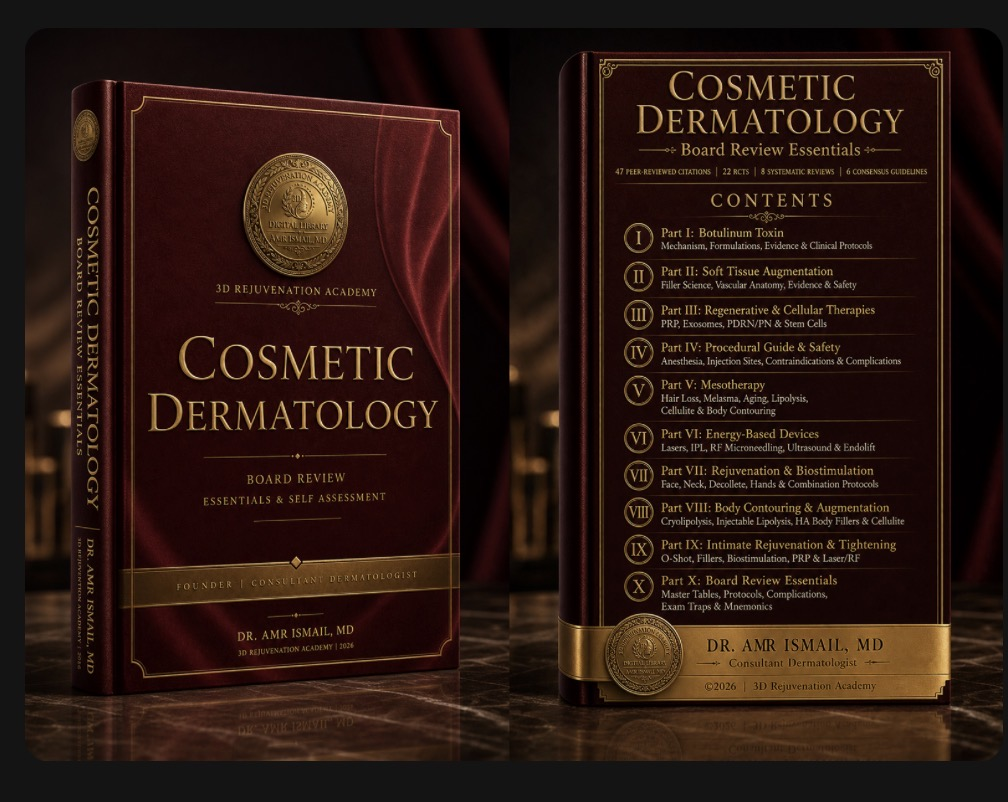
Ten meticulously crafted parts spanning the full spectrum of cosmetic dermatology practice, each grounded in peer-reviewed evidence with clinical trial citations, safety data, and expert protocols.
Botulinum toxin type A remains the cornerstone of non-surgical facial rejuvenation. Covers mechanism of action (SNAP-25 cleavage), type comparison (OnabotulinumtoxinA, AbobotulinumtoxinA, IncobotulinumtoxinA, DaxibotulinumtoxinA), reconstitution protocols, FDA-approved and off-label indications, dosing tables by muscle/region, injection depth/angle guidance, complication management (ptosis, asymmetric smile, brow heaviness), and evidence-based protocols from Carruthers et al. RCTs.
Injectable fillers represent the second most common nonsurgical aesthetic procedure globally. Covers HA filler classification (G-prime, cohesivity, lift capacity), calcium hydroxylapatite, PLLA/PDLA biostimulators, injection planes (subdermal, supraperiosteal), vascular anatomy with danger zones, vascular occlusion recognition and management (LIP response protocol), Tyndall effect correction, nodule management, and the complete HA reversal protocol with hyaluronidase.
Regenerative aesthetics represents the frontier of cosmetic dermatology. Covers PRP preparation protocols (single-spin vs. double-spin, activation methods), evidence-based indications for PRP in facial rejuvenation and hair restoration, exosome therapy (sources, mechanisms, regulatory status), stem cell therapy (adipose-derived vs. bone marrow-derived), and PDRN/PN skin rejuvenation protocols with clinical evidence.
Patient safety is the foundational pillar of aesthetic medicine. Establishes universal safety protocols derived from international guidelines. Covers the TOPPASS pre-procedure safety checklist, topical and local anesthesia protocols, injection sites for facial and body procedures (including mucosal surface of upper and lower lips), absolute and relative contraindications, emergency management protocols, and documentation standards for medicolegal protection.
Mesotherapy, pioneered by Dr. Michel Pistor in 1952, involves intradermal or subcutaneous microinjections of active substances. Covers nappage and point-by-point techniques, mesotherapy for androgenetic alopecia (Dutasteride, Minoxidil, PRP combinations), melasma treatment (TXA 4%, vitamin C, glutathione), facial and neck rejuvenation cocktails, injection lipolysis (PPC/DC, Kybella/deoxycholic acid), cellulite management, and recommended product protocols by indication.
Energy-based devices form the technological backbone of modern aesthetic practice. Covers laser fundamentals (selective photothermolysis, chromophore targeting), ablative vs. non-ablative fractional lasers, IPL systems and indications, radiofrequency microneedling (monopolar, bipolar, fractional), HIFU/MFU ultrasound devices, Endolift diode laser (1470nm/980nm), laser safety protocols (eye protection, fire risk, anesthesia contraindications), and the LASER-TYPE classification mnemonic.
Facial rejuvenation has evolved to a comprehensive, multi-layered approach addressing skin quality, volume restoration, and structural lifting. Covers Profhilo BAP (Bio Aesthetic Points) 5-point injection technique, Sculptra/PLLA poly-L-lactic acid with 5-5-5 post-care rule, Radiesse/CaHA biostimulation, thread lift classification (mono, screw, cog, multi-directional), neck and décolleté rejuvenation protocols, and hand rejuvenation with biostimulators.
Non-surgical body contouring represents one of the fastest-growing segments in aesthetic medicine. Covers cryolipolysis/CoolSculpting (mechanism, applicator selection, paradoxical adipose hyperplasia management), Hyacorp HA fillers for buttock augmentation and contouring, non-invasive skin tightening devices for body (RF, ultrasound), cellulite treatment algorithms, and combination approaches for optimal body sculpting outcomes.
Intimate aesthetic medicine has emerged as a legitimate subspecialty addressing functional and aesthetic concerns. Covers the O-Shot (PRP for female intimate wellness), hyaluronic acid fillers for labial rejuvenation, biostimulation protocols (PRP, exosomes, PDRN) for tissue quality improvement, energy-based devices for vaginal tightening (RF, laser), anatomical considerations, safety protocols, and consent frameworks for intimate procedures.
This culminating section distills the entire curriculum into high-yield board review essentials. Includes comprehensive comparison tables (toxins, fillers, devices), complications management matrix by procedure type, all mnemonics collection (TOPPASS, LIP, 5-5-5, BAP, SNAP-25, LASER-TYPE), exam traps commonly tested on board examinations, self-assessment scorecard with 60 evaluation items, and a complete glossary of 42 essential terms.
Evidence Methodology
⚖ Systematic Evidence Synthesis
This publication employs a systematic evidence synthesis methodology. For each clinical topic, we searched PubMed/MEDLINE, Cochrane Library, and Embase for relevant studies published through Q1 2026. Studies were graded using the Oxford Centre for Evidence-Based Medicine Levels of Evidence. Only human studies published in English-language, peer-reviewed journals were included.
Search Strategy
PubMed/MEDLINE, Cochrane Library, Embase. Procedure-specific keywords, product names, safety outcomes. English-language, peer-reviewed human studies. Excluded: animal studies, case reports (n<5), conference abstracts, manufacturer-sponsored studies without independent validation.
📈 Hierarchy of Evidence
Evidence is classified using the Oxford CEBM framework. This publication prioritizes Level I-II evidence for all clinical recommendations. Level III-IV evidence is explicitly labeled when no higher-level evidence exists.
📖 Primary Evidence Sources
Subscription Plans
Instant digital access. Self-study format. No live sessions required. Choose the plan that fits your practice stage and team size.
Billed annually · $29/mo equivalent
Billed monthly
For residents & trainees building their cosmetic foundation
- Full Digital Book (All 10 Parts)
- Board Review Essentials: Tables, Protocols & Exam Traps
- High-Yield Tables & Protocols
- Downloadable PDF Access
Billed annually · $49/mo equivalent
Billed monthly
For practicing dermatologists & aesthetic physicians
- Everything in Resident
- Chairside Companion PDF
- Procedure Quick-Reference Cards
- Product Comparison Tables
- Priority Content Updates
Billed annually · $149/mo equivalent
Billed monthly · 5 seats
For clinics with up to 5 team members (physicians, RNs, PAs)
- Everything in Clinician
- 5 Individual Seats Included
- Team Progress Dashboard
- Laminated Chairside Cards (Annual)
- Shared Protocol Library
- Multi-Device Access
Standalone purchase · Lifetime access
Add-on or standalone purchase
- 22 Procedural Protocols
- Step-by-Step Injection Guides
- Safety Checklists & Contraindications
- Dosing Tables by Indication
- Complication Management Flowcharts
- Printable A4 Format
Frequently Asked Questions
No. This publication is designed as a comprehensive reference and board review tool to complement — not replace — hands-on supervised training, cadaver workshops, and preceptorships. It provides the evidence base, protocols, and safety frameworks that support clinical practice but does not certify procedural competence. Always practice within your scope of training and licensure.
Unlike manufacturer-sponsored courses or anecdotal training programs, every clinical recommendation in this publication is supported by peer-reviewed citations from PubMed-indexed journals. We prioritize Level I evidence (RCTs, systematic reviews) and clearly label lower levels of evidence. Product comparisons are based on published data, not marketing claims.
After subscribing, you receive instant access to download the complete publication as a PDF. The digital format is optimized for reading on tablets, laptops, and printing selected sections. Your subscription includes access to any content updates published during your subscription period. There are no live sessions — everything is self-study at your own pace.
The 2026 Edition reflects the latest available evidence through Q1 2026, incorporating recent FDA approvals, new consensus guidelines, and landmark publications. Active subscribers receive priority access to content updates as new research and guidelines are published throughout their subscription period.
Safety protocols are derived from international guidelines (ASAPS, ASDS, ASLMS, ESCAD), complications registries (German Aesthetic Dermatology Complications Registry), and FDA safety communications. Every section includes dedicated safety profiles, contraindication lists, complication rates from registry data, and evidence-based emergency management protocols.
Resident ($29/mo): Full book access — ideal for trainees.
Clinician ($49/mo): Adds Chairside Companion + quick-reference cards — best for practicing physicians.
Clinic Team ($149/mo): 5 seats with team dashboard + laminated cards — ideal for multi-provider practices.
Chairside Companion ($149 one-time): Standalone procedural reference — can be added to any tier.
Yes. We offer a 14-day satisfaction guarantee. If the publication does not meet your expectations, contact us within 14 days of purchase for a full refund — no questions asked. After 14 days, annual subscriptions can be cancelled with prorated refund for unused months.
Yes. Evidence and protocols are sourced from international guidelines (ESCAD, ASLMS, ISDS) and peer-reviewed journals worldwide. Product availability may vary by country, and practitioners should always verify regulatory status in their jurisdiction. The clinical evidence base is universally applicable regardless of practice location.
Your Board Review
Starts Here
Join physicians worldwide who trust 3D Rejuvenation Academy for evidence-based continuing education in aesthetic medicine. Instant access to 10,000+ words of peer-reviewed content, 47 clinical citations, and 41 reference tables.