The Skin Longevity · Part I: Foundations of the Skinspan — Three Vectors, One Framework
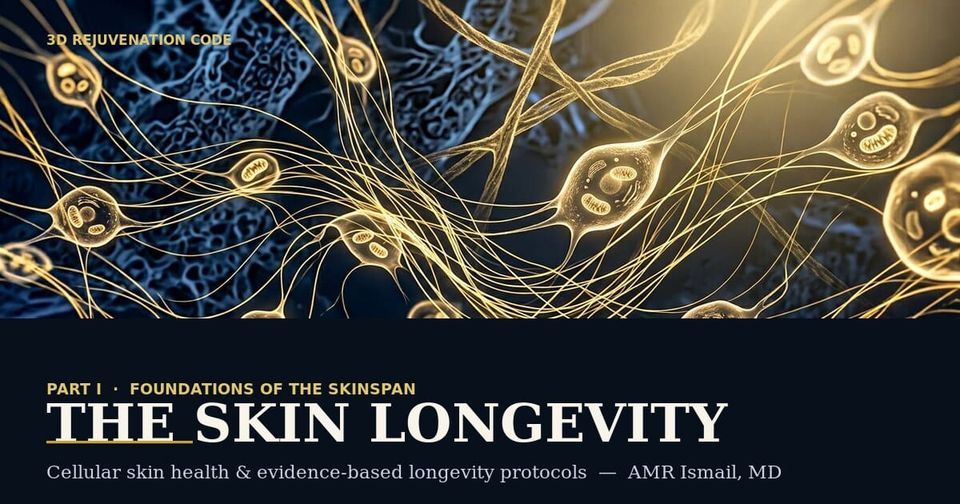
The Skin Longevity — A Science-Based Guide to Cellular Skin Health and Evidence-Based Longevity Protocols. By AMR Ismail, MD, Founder, 3D Rejuvenation Academy. PART I · FOUNDATIONS OF THE SKINSPAN — The New Narrative in Skin Longevity Science.
Redefining the Timeline: Skinspan vs. Anti-Aging
The Science of Functional Skin Health
The Anti-Aging Paradigm: A House Built on Sand. For decades, the skincare industry has sold us a single, seductive promise: that aging is an optional inconvenience, a surface-level problem that can be creamed away, injected away, or lasered away. This is the anti-aging paradigm, and it has governed how we think about, talk about, and treat our skin for more than fifty years. But the anti-aging paradigm is built on a fundamental misunderstanding of what skin actually is and how it actually ages.
The anti-aging model treats the skin as a static surface — a canvas upon which time paints wrinkles, sagging, and discoloration. Within this framework, the goal is simple: erase the marks of time. The toolkit is similarly straightforward: fillers to plump, neurotoxins to paralyze, lasers to resurface, and creams to hydrate. And to be fair, many of these interventions work, at least on the surface.
But here is what the anti-aging paradigm fails to address: the cellular machinery beneath the surface. Your skin is not a canvas. It is a living, dynamic organ system comprising roughly 300 million cells at any given moment, constantly regenerating, communicating, and responding to internal and external signals. When we focus exclusively on surface aesthetics, we miss the deeper story — the story of cellular senescence, mitochondrial dysfunction, barrier compromise, and inflammatory cascade. We treat the symptoms while ignoring the disease process.
This failure has real consequences. Patients who undergo repeated aesthetic procedures without addressing cellular health often find that results become progressively harder to achieve and shorter-lived. Skin becomes thinner, more fragile, less responsive. The "maintenance" cycle accelerates, costs mount, and satisfaction diminishes. Meanwhile, the biological processes driving skin degradation continue unabated beneath the surface, creating what I call biological noise — the chaotic cellular signaling environment that prevents optimal tissue regeneration.
Enter Skinspan: A New Framework for Skin Health
If the anti-aging paradigm asks, "How do we erase the signs of aging?" the skinspan framework asks a fundamentally different question: "How do we extend the period during which skin remains functionally healthy, structurally intact, and biologically resilient?" This is not a semantic distinction. It is a paradigm shift.
Skinspan is defined as the period of a person's life during which their skin maintains functional competence — its ability to perform its biological roles effectively. These roles include barrier protection against pathogens and environmental insults, thermoregulation, immune surveillance, sensory perception, and wound healing. When skinspan is optimal, your skin doesn't just look good; it functions well. It recovers quickly from injury, maintains hydration efficiently, defends against UV damage effectively, and regenerates collagen at a rate that keeps pace with degradation.
The concept of skinspan draws from the broader field of longevity medicine, which has shifted from lifespan — the total number of years lived — to healthspan, the period of life spent in good health. Just as healthspan researchers ask how we maintain physical and cognitive function into advanced age, skinspan research asks how we preserve the skin's functional capacity over time.
Consider this: the same cellular mechanisms that produce visible aging also compromise the skin's functional capacity:
- Senescent cells accumulate with age and secrete inflammatory molecules that break down collagen — simultaneously impairing wound healing and increasing susceptibility to infection.
- Mitochondrial dysfunction reduces cellular energy production — both diminishing the skin's ability to repair UV damage and manifesting as dullness and loss of elasticity.
- Barrier dysfunction allows transepidermal water loss and penetration of irritants — both increasing inflammation and creating the visible signs of dryness, redness, and sensitivity.
The skinspan framework treats these connections as a unified system. Rather than chasing wrinkles with a single product or procedure, we address the underlying cellular processes that produce both functional decline and aesthetic change — working with biology rather than against it.
The Three Pillars of Skinspan
Within the skinspan framework, optimal skin health rests on three interconnected pillars:
1. Cellular vitality — the metabolic health of individual skin cells. At its center are the mitochondria, the organelles responsible for producing ATP, the energy currency of the cell. When mitochondria function optimally, skin cells have the energy they need to synthesize collagen and elastin, repair DNA damage, maintain barrier lipids, and keep skin healthy. When mitochondrial function declines — a process that accelerates after age forty — the skin's capacity for self-repair diminishes with it.
2. Structural integrity — the physical architecture of the skin: the collagen network that provides firmness, the elastin fibers that provide elasticity, the glycosaminoglycans that hold water and volume, and the stratum corneum that provides barrier protection. Structural integrity is not merely about aesthetics; it is about function — wound healing, mechanical protection, infection defense, hydration.
3. Environmental resilience — the skin's ability to withstand and recover from ultraviolet radiation, air pollution, temperature extremes, and chemical irritants, via specialized defense systems: antioxidant enzymes like superoxide dismutase and catalase, DNA repair mechanisms, and the inflammatory response that mobilizes repair. When resilience is compromised, the skin ages faster and recovers slower.
From Surface to Cell: The New Treatment Hierarchy
In the anti-aging paradigm, treatments are organized by symptom: wrinkles get fillers, sagging gets threads or surgery, pigmentation gets lasers, dryness gets moisturizers. In the skinspan paradigm, treatments are organized by cellular target: mitochondrial support, senescent cell clearance, barrier repair, antioxidant replenishment, and inflammation resolution.
The most important question you can ask about any skincare product or procedure is not "What symptom does it treat?" but "What cellular process does it affect?" A moisturizer that merely occludes the surface addresses a symptom; a moisturizer that replenishes ceramides and cholesterol to restore barrier lipid architecture addresses a cellular process. The former provides temporary relief; the latter builds long-term resilience.
This is not to say that neurotoxins, fillers, and lasers have no place in skin longevity medicine. They do. But their effectiveness — and safety — is maximized when deployed within a framework of cellular optimization rather than as standalone symptom treatments.
The 3D Rejuvenation Code: Where Skinspan Meets Clinical Practice
Throughout this book, you will encounter the 3D Rejuvenation Code — three vectors, one framework. It is the diagnostic foundation every specialist protocol is built on: diagnose the biological architecture first, then treat. Profile across three dimensions before choosing your tools:
- ⚡ The Spark — Energy-Based Activation. Physically re-awaken dormant cells through laser and energy-based modulation.
- 🧠 The Brain — Chemical Intelligence Signalling. Reprogram cellular communication with exosomes, PDRN, and biostimulators.
- 🦴 The Bone — Structural Support. Re-tension sagging tissue through deep structural scaffolding — not volume.
The cellular optimization strategies discussed in this book are what the Spark aims to achieve — and the skinspan foundations of Part I are the lens through which all three vectors are read. The Spark is the foundation upon which all subsequent rejuvenation efforts are built: clearing biological noise, restoring cellular vitality, and preparing the skin's ecosystem for advanced intervention.
The Spark Phase is not optional preprocessing. It is the essential first act of any comprehensive rejuvenation strategy. Attempting to stimulate collagen with microneedling, lasers, or biostimulators on skin that is inflamed, barrier-compromised, or metabolically depleted is like planting seeds in depleted soil: some growth may occur, but results will be suboptimal, recovery prolonged, and complication risk elevated.
"When I first came to the clinic, I was spending over $800 a month on skincare products and getting fillers every six months. My skin looked — okay. And every year, I needed more filler to achieve less result. When my dermatologist introduced me to the skinspan concept, it was a revelation… We stopped all procedures for three months and focused exclusively on barrier repair, mitochondrial support, and inflammation reduction. At the four-month mark, my skin started to look better than it had in years. And when we finally reintroduced a small amount of filler, the result was dramatic — natural, beautiful, and long-lasting. I don't chase anti-aging anymore. I build skinspan." — M.C., 52, former "skincare junkie," now a skinspan advocate
Measuring Skinspan: Objective Markers of Skin Health
While the anti-aging paradigm relies on subjective assessments of appearance, the skinspan framework incorporates quantitative biomarkers of cellular and functional health:
| Biomarker | What it measures | Why it matters |
|---|---|---|
| TEWL (transepidermal water loss) | Barrier function | A compromised barrier allows excessive water loss → dryness, irritation, environmental susceptibility |
| Cutometry | Elasticity & firmness | Reduced rebound indicates elastin degradation and collagen network compromise |
| Dermoscopy / reflectance confocal microscopy | Collagen density, vascular patterns, cellular morphology in vivo | Cellular-level assessment without biopsy |
| Raman spectroscopy | Antioxidant levels, lipid content, collagen cross-linking | The molecular fingerprint of skin health |
In clinical practice, patients following the skinspan protocols typically show measurable improvements in TEWL, elasticity, and antioxidant capacity within twelve weeks — often before visible changes become apparent. Cellular optimization works from the inside out: function improves first, then structure, then appearance. The mirror is the last place you see the change, not the first.
MYTH: Aging is primarily caused by external factors like sun exposure and pollution, so good sunscreen and avoiding pollution are enough to prevent it.
TRUTH: While extrinsic factors account for up to 80% of visible facial aging, intrinsic aging — the cellular processes driven by genetics, mitochondrial function, and senescence — occurs even in sun-protected skin. Sunscreen is necessary but not sufficient. A comprehensive approach must address both intrinsic and extrinsic aging mechanisms.
Clinical Takeaway
The skinspan framework replaces the anti-aging paradigm with a biologically grounded approach that prioritizes cellular vitality, structural integrity, and environmental resilience. Your skin is not a canvas to be decorated but a living organ system that requires systematic care at the cellular level. Every product and procedure you choose should be evaluated not by what symptom it treats but by what cellular process it supports. The goal is not to erase time but to extend the period during which your skin remains functionally healthy and biologically resilient.
Scientific sources & further reading
- Skin Aging — MedlinePlus, US National Library of Medicine (NIH)
- 11 ways to reduce premature skin aging — American Academy of Dermatology
- How dermatologists treat sun-damaged skin — AAD
- Ultraviolet radiation fact sheet — World Health Organization
- Society for Investigative Dermatology — skin aging research
- PubMed: skin aging & mitochondria · cellular senescence & skin · transepidermal water loss
Educational content on skin longevity science — not medical advice, diagnosis, or treatment. Consult a licensed physician before starting any protocol or procedure.
© AMR Ismail, MD · 3D Rejuvenation Academy · www.3drejuvenationcode.com
Take the 3D Skin Architecture Assessment Explore the Full Curriculum The 3D Rejuvenation Code on Amazon